

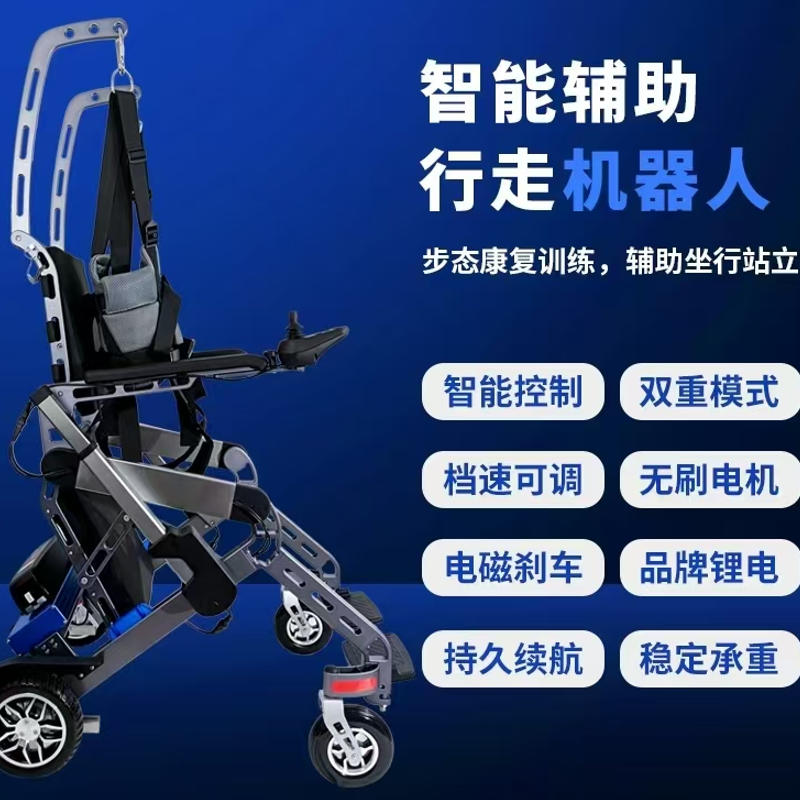
The HKXZ-2101 Assistive Walking Robot is a pioneering multi‑functional autonomous standing and weight‑supported gait trainer, specifically developed for lower‑limb rehabilitation. It is primarily indicated for patients with walking disabilities resulting from stroke, spinal cord injury, trauma, Guillain‑Barré syndrome, and other neurological or musculoskeletal conditions.
This device integrates the core principles of Body Weight‑Supported Treadmill Training (BWSTT) —a rehabilitation technique that has been widely studied and applied since the 1980s, and has become a major focus in modern rehabilitation medicine. By enabling early, safe, and effective gait training, the HKXZ-2101 helps patients regain their walking ability—often their primary goal—while reducing the risk of long‑term complications such as uneven gait and spinal deformity.
Product Features
Innovative Autonomous Standing & Safe Walking Assistance
The HKXZ-2101 is the industry’s first multi‑functional autonomous standing and weight‑supported gait trainer. It allows patients to independently stand and perform gait training without the need for constant physical assistance from therapists or caregivers, thus reducing manual labor and improving training efficiency.
Weight‑Supported Gait Training (BWSTT) Core Technology
The device uses a suspension system to offload a portion of the patient‘s body weight, enabling safe and repetitive practice of walking patterns. This approach addresses the key limitations of traditional training, which often over‑relies on the healthy limb, leading to shortened stance phases on the affected side and an uneven, discontinuous gait. BWSTT promotes balanced weight‑bearing, stepping, and stability—three essential elements for restoring natural walking.
Early‑Intervention & Proven Efficacy
According to rehabilitation research, BWSTT allows early intervention for stroke patients, providing intensive walking training that combines weight‑bearing, stepping, and balance. Clinical studies cited in the manual show that this method yields significant short‑term and long‑term therapeutic outcomes, improving both walking ability and balance function.
Versatile & Unrestricted Use
The device is designed for flexibility—it can be used in both clinical settings and at home, without limitations of time or location. This enables patients to perform rehabilitation exercises daily, which is critical for recovery.
Comprehensive Clinical Applications
The HKXZ-2101 supports multiple rehabilitation therapy codes as per the Chinese medical insurance catalog, including:
-
Motor Therapy (340200020)
-
Weight‑Supported System Training (340200021)
-
Wheelchair Function Training (340200022)
-
Electric Standing Bed Training (340200023)
-
Balance Function Training (340200024)
-
Hemiplegic Limb Comprehensive Training (340200040)
-
Cerebral Palsy Limb Comprehensive Training (340200041)
-
Paraplegic Limb Comprehensive Training (340200042)
Clinical Benefits & Mechanisms
Improving Gait Symmetry
Traditional gait training often emphasizes isolated joint movements (e.g., separate stepping, balance, and weight‑shift exercises). However, this approach does not replicate real‑world walking conditions, resulting in patients who can perform isolated movements well but walk poorly. Studies indicate that hemiplegic patients tend to rely heavily on the healthy limb, leading to shortened stance time on the affected side and prolonged double‑support phases, which disrupt the kinetic and potential energy exchange in walking. This causes uneven gait and, over time, may lead to spinal deformation. BWSTT directly addresses this by ensuring adequate weight‑bearing on the affected limb during training.
Brain Plasticity & Motor Re‑learning
The theory of brain plasticity suggests that task‑specific training can enable most stroke patients to successfully undergo motor re‑learning. BWSTT provides intensive, repetitive practice of the complete walking cycle, facilitating neural reorganization and functional recovery.
Reduction of Complications
By promoting symmetrical weight‑bearing and proper gait mechanics, the HKXZ-2101 helps prevent secondary issues such as muscle atrophy, joint contractures, and spinal misalignment, which are common in patients who remain non‑ambulatory for extended periods.
Intended Use Cases
| Application Area | Description |
|---|---|
| Stroke (Hemiplegia) | Early‑intervention BWSTT to restore walking and balance function |
| Spinal Cord Injury | Weight‑supported gait training for paraplegic and incomplete injury patients |
| Traumatic Brain Injury | Gait re‑education and balance training |
| Guillain‑Barré Syndrome | Progressive strength and walking rehabilitation |
| Orthopedic Conditions | Post‑surgical or post‑fracture lower‑limb rehabilitation |
| Cerebral Palsy | Comprehensive limb training to improve motor function and reduce disability |
| Elderly & Frail Patients | Safe gait training with reduced fall risk |
Social & Economic Benefits
For Hospitals & Rehabilitation Centers:
-
Multi‑functionality – One device supports multiple training programs, increasing equipment utilization and expanding treatment offerings.
-
Reduced workload – Automates weight‑bearing and stepping assistance, decreasing therapist physical effort and labor costs.
-
Space‑efficient – Compact design compared to traditional overhead track or treadmill‑based systems, saving valuable floor space.
-
Enhanced reputation – Equipping with advanced rehabilitation technology supports the development of specialty departments and attracts more patients.
-
Revenue generation – High‑frequency use translates into direct economic returns.
For Families & Individual Patients:
-
Reduced caregiver burden – Patients can train autonomously, freeing family members from constant physical support.
-
Cost savings – Home‑based training reduces the need for prolonged inpatient stays or frequent clinic visits.
-
Flexible scheduling – Training can be done at any time, without appointment constraints.
-
Improved confidence & quality of life – Visible progress enhances motivation and psychological well‑being.
Technical Specifications (as per registration)
| Item | Details |
|---|---|
| Product Name | Assistive Walking Robot (Electric Patient Lifter – 电动移位机) |
| Model | HKXZ-2101 |
| Medical Device Registration | 粤深械备20220831 |
| Production License | 粤深药监生产备20220026号 |
| Primary Function | Autonomous standing, weight‑supported gait training, balance training |
| Target Conditions | Stroke, spinal cord injury, trauma, Guillain‑Barré, cerebral palsy, hemiplegia, paraplegia |
| Application Settings | Hospitals, rehabilitation centers, home care |
| Key Technology | Body Weight‑Supported Treadmill Training (BWSTT) |
| Training Modes | Motor therapy, weight‑supported training, balance training, limb comprehensive training |
All information is based on official product documentation. Specifications and registration details are subject to regulatory updates.
Why Choose HKXZ-2101?
-
Clinically Proven – Based on BWSTT, a widely researched and effective rehabilitation technique
-
Early Intervention – Enables safe gait training soon after onset, maximizing recovery potential
-
Autonomous Operation – Reduces reliance on therapists and caregivers
-
Versatile Applications – Supports a wide range of neurological and musculoskeletal conditions
-
Home‑Use Friendly – Compact, portable, and no site or time restrictions
-
Cost‑Effective – One device covers multiple therapy codes, delivering high value
-
Regulatory Compliant – Registered medical device with full Chinese regulatory approval