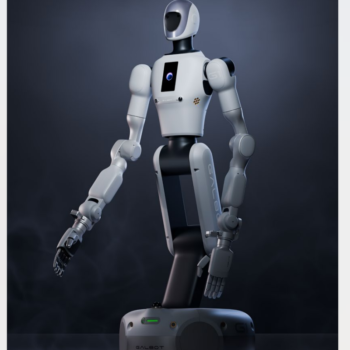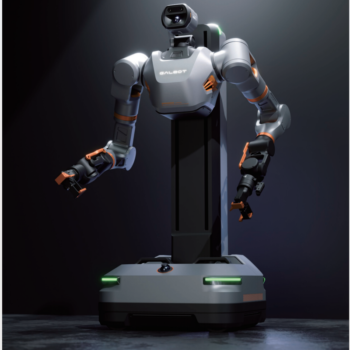


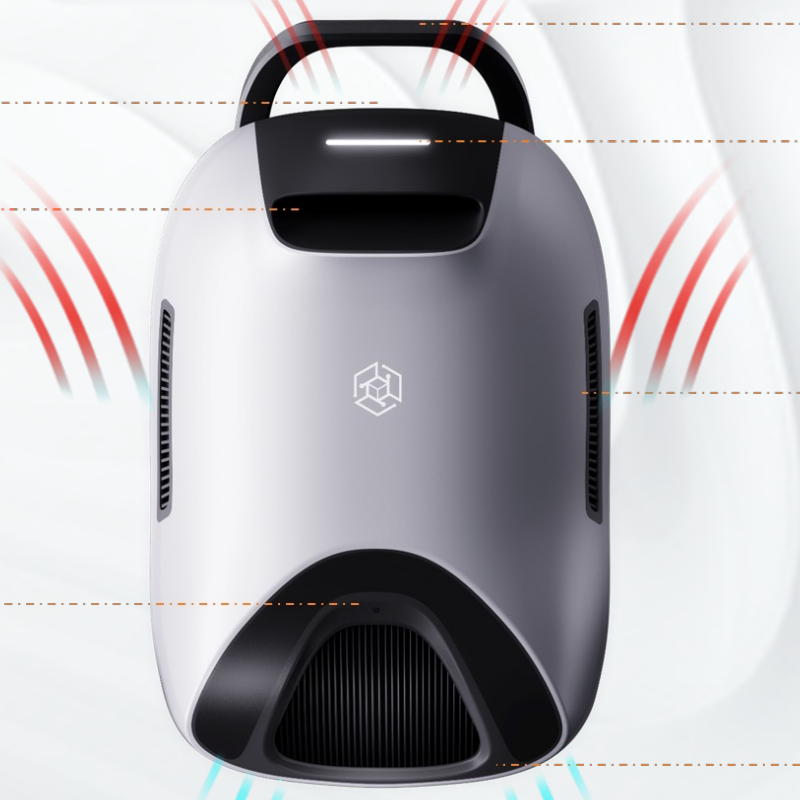
The BotPack Series is a portable edge AI computing platform designed specifically for robotics and embodied intelligence applications. Powered by the latest NVIDIA Jetson Thor architecture, BotPack provides exceptional GPU acceleration, high-speed networking, and rich peripheral interfaces, enabling robots to perform complex AI inference entirely at the edge.
Available in B4 and B5 models, BotPack supports a wide range of intelligent robotic systems including humanoid robots, quadruped robots, autonomous mobile robots (AMRs), robotic arms, autonomous vehicles, and research platforms.
Its compact form factor, industrial-grade design, and comprehensive I/O make it an ideal onboard computing solution for real-time perception, navigation, SLAM, VLA (Vision-Language-Action), and multimodal AI.
Key Features
NVIDIA Jetson Thor Computing Platform
Built on NVIDIA’s latest Jetson Thor architecture for next-generation robotics.
- NVIDIA Jetson Thor T4000 (B4)
- NVIDIA Jetson Thor T5000 (B5)
- Blackwell GPU Architecture
- FP4 AI Computing
- Massive parallel GPU acceleration
Exceptional AI Performance
Designed for demanding AI workloads.
- Up to 2070 TFLOPS FP4 AI Performance
- Large Vision Models
- Vision-Language Models (VLM)
- Vision-Language-Action (VLA)
- Deep Learning Inference
- Robot Foundation Models
Rich Industrial Interfaces
Provides abundant connectivity for robotic systems.
- USB 3.1 Type-A
- USB Type-C
- Gigabit Ethernet
- 10G Ethernet
- EtherCAT
- MiniIO Expansion
- DisplayPort
- PoE Support
Advanced Wireless Connectivity
Reliable communication for mobile robotic applications.
- Wi-Fi 7
- Bluetooth 5.4
- 5G
- LTE-FDD / LTE-TDD
- WCDMA
- UWB Positioning
- Dual-band Operation
Built for Robotics
Ideal for onboard deployment in intelligent robotic platforms.
- Humanoid Robots
- Quadruped Robots
- Autonomous Mobile Robots
- Mobile Manipulation
- UAV Systems
- Autonomous Vehicles
- Industrial Inspection Robots
Technical Specifications
| Specification | BotPack B4 | BotPack B5 |
|---|---|---|
| Processor | NVIDIA Jetson Thor T4000 | NVIDIA Jetson Thor T5000 |
| AI Performance | 1200 TFLOPS (FP4) | 2070 TFLOPS (FP4) |
| GPU | 1536-core Blackwell GPU (6 TPCs) | 2560-core Blackwell GPU (10 TPCs) |
| GPU Frequency | Up to 1.53 GHz | Up to 1.57 GHz |
| CPU | 12-core Neoverse V3AE 64-bit | 14-core Neoverse V3AE 64-bit |
| CPU Frequency | Up to 2.6 GHz | Up to 2.6 GHz |
| Memory | 64GB LPDDR5X (273 GB/s) | 128GB LPDDR5X (273 GB/s) |
| Storage | 128GB SSD + 2TB NVMe SSD | 128GB SSD + 2TB NVMe SSD |
| USB | 3 × USB 3.1 Type-A + 1 × USB Type-C | Same |
| Display | 1 × DisplayPort | Same |
| Wireless | Wi-Fi 7 + Bluetooth 5.4 | Same |
| Cellular | 5G / LTE | Same |
| UWB | IEEE 802.15.4 Standard | Same |
| Navigation | 6-Axis IMU + L1/L5 GNSS | Same |
| Ethernet | 5 × Gigabit Ethernet, 10G RJ45, EtherCAT | Same |
| Input Voltage | DC 9–33V / PoE 48V | DC 9–33V / PoE 48V |
| Maximum Power | 140W | 200W |
| Operating Temperature | -30°C to +60°C | -30°C to +60°C |
| Dimensions | 326 × 196 × 105 mm | 326 × 196 × 105 mm |
| Weight | < 2.5 kg | < 2.5 kg |
Typical Applications
- Embodied AI
- Humanoid Robotics
- Autonomous Mobile Robots (AMR)
- Autonomous Driving
- SLAM & Navigation
- Computer Vision
- Vision-Language-Action (VLA)
- Vision-Language Models (VLM)
- Robot Learning
- Industrial Inspection
- Warehouse Automation
- Robotics Research
- Edge AI Computing
Why Choose BotPack?
- Latest NVIDIA Jetson Thor architecture
- Up to 2070 TFLOPS FP4 AI performance
- Industrial-grade reliability
- Compact backpack design for onboard deployment
- Rich communication interfaces
- 5G + Wi-Fi 7 + UWB connectivity
- Designed specifically for robotics and embodied AI
- Supports ROS2, CUDA, TensorRT, Isaac ROS, and mainstream AI development frameworks
Product Models
| Model | Recommended Applications |
|---|---|
| BotPack B4 | Mobile robots, collaborative robots, autonomous inspection, edge AI applications requiring high performance with optimized power consumption. |
| BotPack B5 | Humanoid robots, large AI models, Vision-Language-Action (VLA), multimodal AI, autonomous driving, and advanced embodied AI research requiring maximum computing performance. |