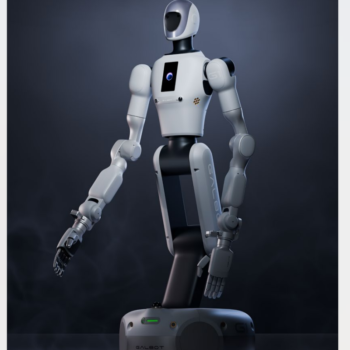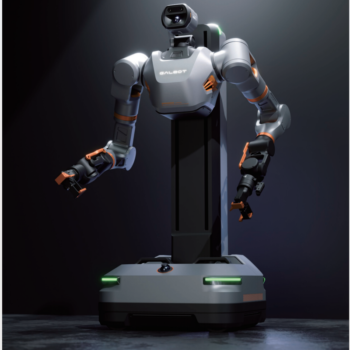


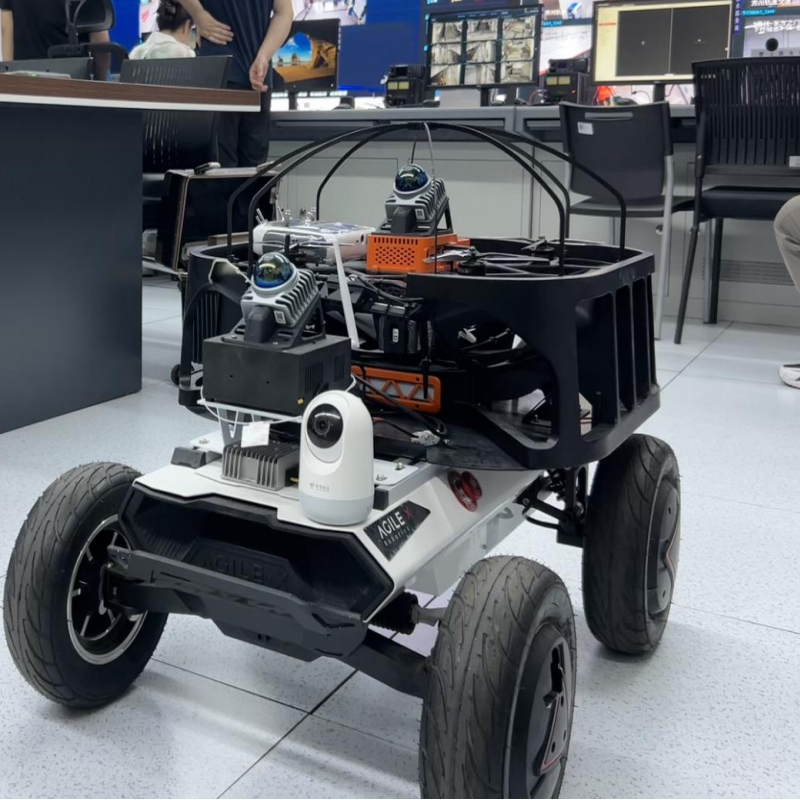
The Autonomous Air-Ground Collaborative Inspection Robot System integrates an intelligent unmanned ground vehicle (UGV) with an autonomous UAV into a unified inspection platform. By combining ground mobility with aerial flexibility, the system provides comprehensive 3D inspection capabilities for complex industrial environments while reducing manual intervention and improving operational efficiency.
Designed for continuous autonomous operation, the system supports mission planning, automatic navigation, obstacle avoidance, coordinated robot scheduling, automatic charging, and remote monitoring. It is suitable for both indoor and outdoor inspection scenarios.
Key Features
Autonomous Air-Ground Collaboration
The UAV and UGV work together to inspect facilities from multiple perspectives, enabling complete coverage of complex environments that are difficult for conventional inspection systems.
Intelligent Autonomous Navigation
Advanced SLAM navigation, real-time localization, and autonomous path planning allow the robots to complete inspection tasks with minimal human supervision.
Intelligent Obstacle Avoidance
Equipped with LiDAR, depth perception, and environmental sensing, the system detects and avoids obstacles automatically to ensure safe operation.
Automatic Charging & Continuous Operation
The drone and ground robot support autonomous docking and charging, enabling scheduled inspection missions with minimal downtime.
Indoor & Outdoor Deployment
Suitable for factories, substations, industrial parks, warehouses, tunnels, campuses, energy facilities, and other complex environments.
Remote Monitoring & Data Management
Inspection data, images, videos, alarms, and robot status can be monitored remotely through a centralized management platform.
Technical Specifications
Ground Robot Onboard Computer
| Item | Specification |
|---|---|
| Model | Intel NUC12DCMi7 |
| Processor | Intel Core i7-12700 (2.1 GHz Base, 4.9 GHz Turbo) |
| Memory | 8 GB DDR4 3200 MHz |
| Storage | 500 GB SSD |
| Graphics | Intel UHD Graphics 770 |
| Connectivity | Wi-Fi 6E, Bluetooth 5.2 |
| Interfaces | 6 × USB 3.2, 2 × USB Type-C |
| Dimensions | 357 × 189 × 120 mm |
| Power Consumption | 30–60 W |
(Based on the product specification.)
LiDAR Specifications
| Item | Specification |
|---|---|
| Model | Mid-360 |
| LiDAR Type | Hybrid Solid-State |
| Laser Safety | Class 1 Eye-Safe |
| Measurement Accuracy | 3–5 cm |
| Detection Range | 40 m @ 10% Reflectivity / 70 m @ 80% Reflectivity |
| Scan Frequency | 10 / 20 Hz |
| Point Rate | ≤ 200,000 points/sec |
| Field of View | 360° Horizontal, 120° Vertical |
(Based on the product specification.)
Typical Applications
- Power Substation Inspection
- Industrial Plant Inspection
- Petrochemical Facilities
- Warehouses & Logistics Centers
- Underground Tunnels
- Smart Campuses
- Mining Operations
- Energy Infrastructure
- Large Manufacturing Plants
- Public Safety Patrols
Advantages
- Autonomous coordinated air-ground inspection
- Intelligent obstacle avoidance
- Indoor and outdoor operation
- Automatic charging and mission scheduling
- High-precision autonomous navigation
- Remote monitoring and centralized management
- Reduced labor costs and improved inspection efficiency
Product Upgrade Option
A Tethered Air-Ground Collaborative Inspection Robot version is also available. This upgraded model features continuous ground-powered drone operation for significantly extended flight endurance, adaptive tether management, omnidirectional ground mobility, and fully autonomous return-to-charge capabilities, making it ideal for long-duration inspection missions.