



Developed by LIMX Dynamics – a leading embodied intelligence company founded in 2022, backed by a $200 million Series B funding round with investments from JD.com and NIO Capital, and the same team behind the full‑size humanoid robot Oli – the TRON 2 is a breakthrough modular embodied robot that can transform between three distinct configurations using a single main body. Built on the design philosophy of an “embodied robot universal base,” TRON 2 utilizes a comprehensive modular architecture that allows rapid switching between three core configurations without additional modifications: dual‑arm (stationary manipulation), bipedal (agile walking and stair‑climbing), and dual‑wheeled legs (stable all‑terrain mobility). It also supports future expansion into humanoid and quadruped forms. With fully open APIs and standardized hardware interfaces, TRON 2 supports integration of voice, vision, and other multimodal perception suites, delivering an all‑terrain, all‑scenario “one‑stop” embodied development platform for VLA (Vision‑Language‑Action) research, mobile manipulation, and whole‑body motion control.
Three Configurations in One Body – Unprecedented Flexibility
| Configuration | Key Specifications & Capabilities |
|---|---|
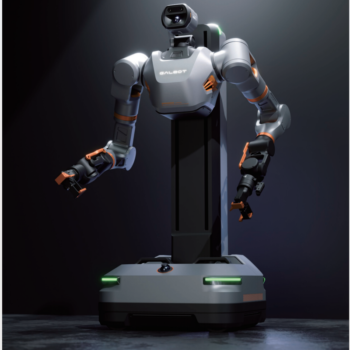
| Dual‑Arm Mode | 7‑DOF humanoid‑inspired arms, 70 cm reach (the largest workspace in its class), 10 kg payload per arm, 60 kg full‑body load limit – enables fine manipulation and industrial‑grade handling |
| Bipedal Mode | Enhanced motion control with visual perception integration, capable of step‑by‑step stair climbing on real stairs, ideal for navigating complex human environments |
| Dual‑Wheeled Mode | 30 kg payload capacity with all‑terrain mobility, 4‑hour runtime, new auto‑recharging function – ready for extended research and light industrial delivery tasks |
Beyond these three core configurations, TRON 2‘s modular architecture supports future upgrades into humanoid, quadruped, and additional forms. A single machine can adapt to every task – from precision desktop operations to complex terrain traversal.
Dual‑Arm System – Industry‑Leading Manipulation for VLA Research
TRON 2‘s dual‑arm system is the most powerful manipulation platform in its class, purpose‑built for Vision‑Language‑Action (VLA) research:
-
7 degrees of freedom per arm – humanoid joint design with fast, stable joint response ensuring highly consistent motion planning and execution
-
70 cm reach + expansive workspace envelope – the largest workspace of any robot in its class, enabling access to high, distant, and wide‑range positions
-
Spherical humanoid wrist design – 7‑DOF configuration with high dexterity and precision, allowing effortless operation even in confined spaces
-
10 kg payload per arm, 60 kg full‑body limit – handles industrial‑grade tasks including lifting, transporting, and material handling
-
Industry‑leading motion control algorithms – 100ms teleoperation latency for near‑real‑time remote control
-
Front camera full coverage – complete visibility of the arm span, ensuring precise control during teleoperation
-
Safety boundary protection – mechanical collision prevention to avoid equipment damage
-
Dual redundant power design – if power is interrupted, arms automatically and slowly retract to a safe parked position, ensuring operational safety
The high degrees of freedom, high precision, and high payload of TRON 2‘s arm system make VLA operations executable across desktop, 3D space, and real‑world scenarios – genuinely supporting multi‑domain VLA research and deployment.
Integrated VLA Platform – Ready for Next‑Generation AI Research
TRON 2 is a native all‑in‑one VLA platform that streamlines the entire development workflow from data collection, cleaning, and annotation to training, inference, and task management. Key features include:
-
Mainstream VLA model compatibility – direct out‑of‑box support for Pi 0.5 and ACT, the leading VLA architectures in the research community
-
10 typical operation task datasets – pre‑packaged examples covering food preparation, table cleaning, clothing handling, item organization, package delivery, and more
-
Model training and algorithm deployment examples – no additional debugging required, plug‑and‑play for immediate research use
-
Native data acquisition and management platform – closed‑loop system covering collection, training, validation, and real‑robot deployment, accelerating research timelines
-
Comprehensive tutorial resources – master VLA in just 2 hours with pre‑loaded standard algorithm tasks, allowing researchers to focus on innovation rather than parameter tuning
All‑Terrain Mobility – Bipedal and Wheeled Legs for Any Environment
TRON 2 integrates LIMX Dynamics‘ deep expertise in bipedal robot motion control and hardware:
-
Bipedal mode – strengthened motion and obstacle avoidance capabilities with visual perception integration; capable of climbing real stairs step‑by‑step, expanding operations into more diverse and realistic environments such as homes and research spaces
-
Dual‑wheeled mode – 30 kg maximum payload with 4‑hour runtime, providing ample margin for mounting additional sensors and peripherals; new auto‑recharging capability meets diverse research and industrial needs
-
Upgraded from TRON 1‘s minimalist bipedal configuration, TRON 2 represents the next generation of embodied robotic general hardware platforms
Open Development Ecosystem – Lower Barriers, Smoother Development
TRON 2 provides complete, easy‑to‑use secondary development documentation and tools:
-
30‑minute learning curve – get familiar with operation in 30 minutes
-
2‑hour full deployment – complete the entire workflow from environment setup to real‑robot deployment within 2 hours
-
Full Python development support – comprehensive Python API for all development tasks
-
ROS 1 & ROS 2 compatibility – seamless integration with the ROS ecosystem, supporting both ROS1 and ROS2 environments
-
Fully open SDK – provides both high‑level abstractions and low‑level hardware access; SDKs and APIs support invocations in ROS1, ROS2, and non‑ROS environments
-
URDF file included – clear and complete URDF documentation for optimized simulation‑to‑real (Sim2Real) performance
-
Professional documentation – comprehensive user manual and secondary development guide
-
Mainstream simulation support – compatible with NVIDIA Isaac Sim, MuJoCo, Gazebo, and other leading platforms
-
Ongoing updates – continuous secondary development updates via GitHub, with deployment code open‑sourced on LIMX Dynamics‘ GitHub repository
The SDK provides interfaces and examples for obtaining IMU and joint state data, with deployment code fully open‑sourced. A cross‑platform low‑level motion control development interface library offers unified C++/Python APIs, achieving rapid migration and deployment of motion control algorithms. Through hardware abstraction layers and standardized communication protocols, developers can seamlessly switch between simulation and real hardware environments.
Key Application Scenarios
| Scenario | Application Description |
|---|---|
| VLA Research & Development | Vision‑Language‑Action model research and deployment, embodied AI algorithm development, multi‑modal perception and manipulation studies – built as a native VLA platform |
| Academic Research & Education | Robotics research in university labs, locomotion algorithm development, manipulation and grasping studies, human‑robot interaction research, reinforcement learning training and validation |
| Industrial & Logistics | Parts sorting, material handling, item picking and placing, warehouse logistics support, light assembly tasks – 10 kg payload handles industrial‑grade tasks |
| Manufacturing & Automation | Production line material transport, precision assembly operations, quality inspection tasks, human‑robot collaboration in factory environments |
| Mobile Manipulation Research | Combination of bipedal locomotion with manipulation tasks, real‑world deployment across stairs and obstacles, whole‑body coordination studies |
| Home & Service Robotics | Research into home service automation, food preparation studies, table cleaning research, clothing handling, item organization, and package delivery – pre‑packaged with 10 typical home task datasets |
| Security & Inspection | Facility patrol in wheeled mode, autonomous navigation with auto‑recharging, 30 kg payload for mounting inspection sensors |
Technical Specifications Overview
| Parameter | Details |
|---|---|
| Configuration Options | Dual‑arm, Bipedal, Dual‑Wheeled (plus future humanoid / quadruped expansion) |
| Arm DOF | 7 per arm (humanoid joint design) |
| Arm Reach | 70 cm (largest workspace in its class) |
| Arm Payload | 10 kg per arm |
| Full‑Body Load Capacity | 60 kg |
| Wheeled Mode Payload | 30 kg |
| Wheeled Mode Runtime | 4 hours |
| Auto‑Recharging | Supported in wheeled mode |
| Teleoperation Latency | 100ms (industry‑leading) |
| Safety Features | Safety boundary protection, dual redundant power design |
| VLA Model Support | Pi 0.5, ACT, with pre‑packaged datasets and training examples |
| Typical Tasks Pre‑Packaged | 10 (food prep, table cleaning, clothing handling, item organization, package delivery, etc.) |
| Development Ecosystem | Full Python, ROS 1 / ROS 2, fully open SDK, URDF |
| Simulator Support | NVIDIA Isaac Sim, MuJoCo, Gazebo |
| SDK Access | High‑level and low‑level APIs, IMU and joint state data, open‑source deployment code |
| Deployment Time | 30‑minute learning curve, 2 hours from setup to real‑robot deployment |
| Hardware Interfaces | Fully open API, standardized interfaces for voice and vision integration |
Comparison with Oli – Understanding LIMX‘s Product Matrix
| Feature | TRON 2 | Oli |
|---|---|---|
| Primary Use | Modular research platform, VLA development, mobile manipulation | Full‑size humanoid for commercial service, research, industrial |
| Height / Form Factor | Modular – arms, bipedal, or wheeled | 165 cm humanoid (175 cm Super) |
| Key Differentiator | Reconfigurable configurations in one body | Full humanoid form with COSA OS |
| Target Audience | VLA researchers, mobile manipulation labs | AI researchers, commercial service, industrial inspection |
| Arm DOF | 7 per arm | 7 per arm |
| Arm Payload | 10 kg per arm | 3 kg per arm |
| Full‑Body Load | 60 kg | N/A |
| Operating System | Open SDK (ROS 1/2, Python) | COSA (Agentic OS) |
| VLA Support | Native VLA platform, Pi 0.5/ACT | Supported via COSA |
Why Choose LIMX Dynamics TRON 2?
-
Three configurations in one body – no need to purchase multiple robots; switch between dual‑arm, bipedal, and wheeled setups as research needs evolve
-
Largest workspace in its class – 70 cm arm reach with a spherical wrist design covers more operational points and task types than any competitor in the same class
-
Industry‑leading motion algorithms – 100ms teleoperation latency and safety boundary protection for precise, confident control
-
Native VLA platform – purpose‑built for Vision‑Language‑Action research from the ground up, not retrofitted
-
Rapid deployment – 30‑minute learning curve, 2 hours from environment configuration to real‑robot deployment
-
Truly open development ecosystem – full Python, ROS 1 & 2 support, fully open SDK with low‑level access, complete URDF, and mainstream simulator compatibility
-
Research‑validated performance – demonstrated ability to handle 10 typical operation tasks out‑of‑the‑box, with pre‑packaged datasets for Pi 0.5 and ACT
-
Powered by industry leader – LIMX Dynamics brings the same team behind the 165 cm humanoid Oli and $200M in funding, with proven expertise in both manipulation and locomotion
Availability and Support
-
Open for pre‑order on the LIMX Dynamics official website
-
Comprehensive development documentation and technical support channels
-
Cloud‑based updates and secondary development resources
-
Developer portal access for SDK, API documentation, simulation resources, and open‑source ecosystem
-
Optional on‑site commissioning for enterprise and research fleets


There are no reviews yet.